

The New American Left
One in five Americans, and nearly two in five of the young, now see Communism in a positive light

This summer, America celebrated the 250th anniversary of its founding. At the same time, the Cato Institute, a libertarian think tank whose entire institutional purpose is the defence of free markets, commissioned a survey with Morning Consult of 2,253 American adults. The survey included the usual questions: pride in country, knowledge of what the anniversary commemorated, and belief in the American Dream.

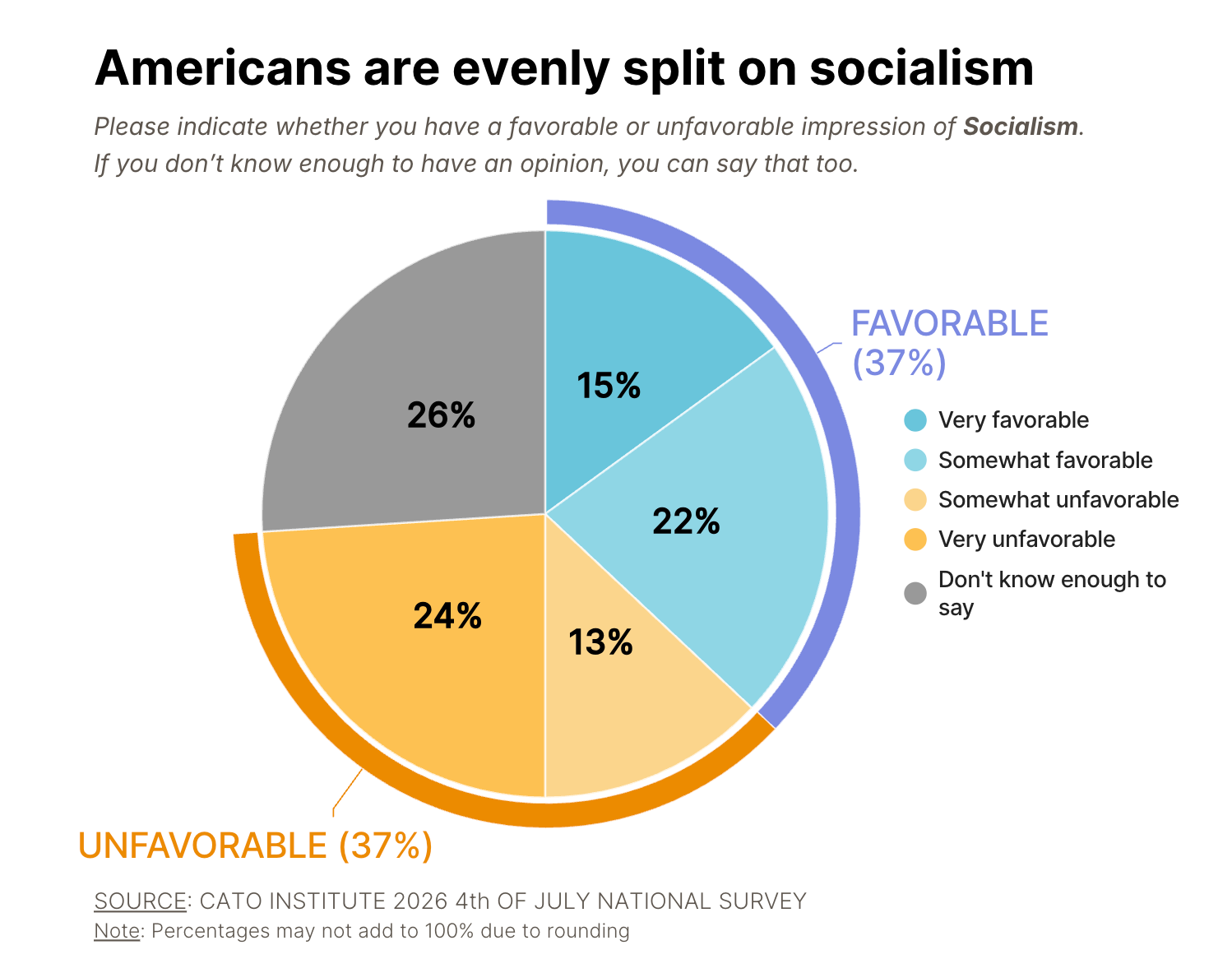
Besides the typical civic questions, the Cato questionnaire also asked Americans their feelings on communism, socialism and capitalism. The responses were quite explosive; the survey’s authors reported that: 21 percent of Americans said they held a favourable view of communism.1
Not socialism but communism. The word itself, which to the older Western mind is attached to the gulag and the Stasi and the Cultural Revolution, the one that American politics spent literally seven decades treating as roughly synonymous with treason.
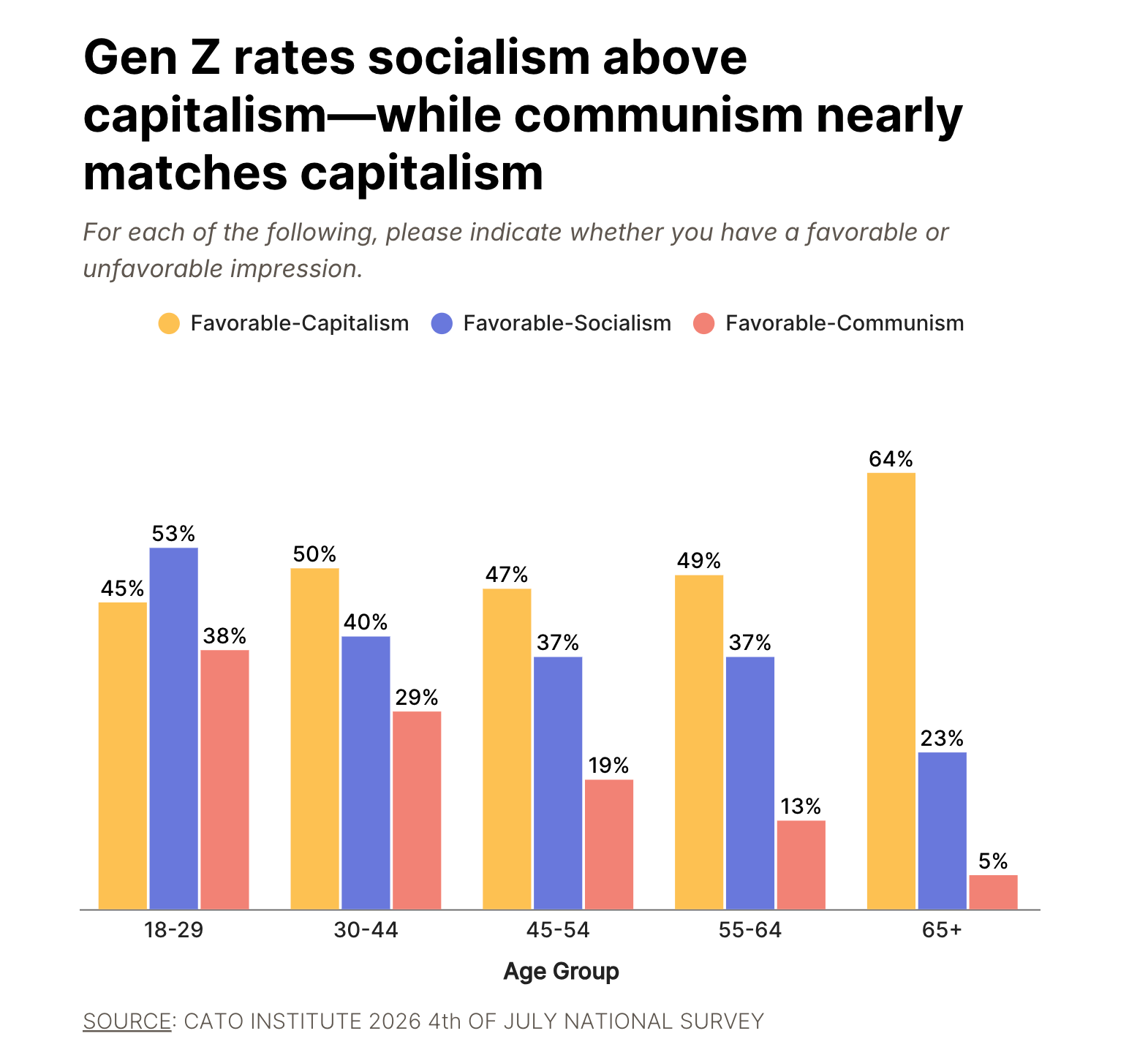
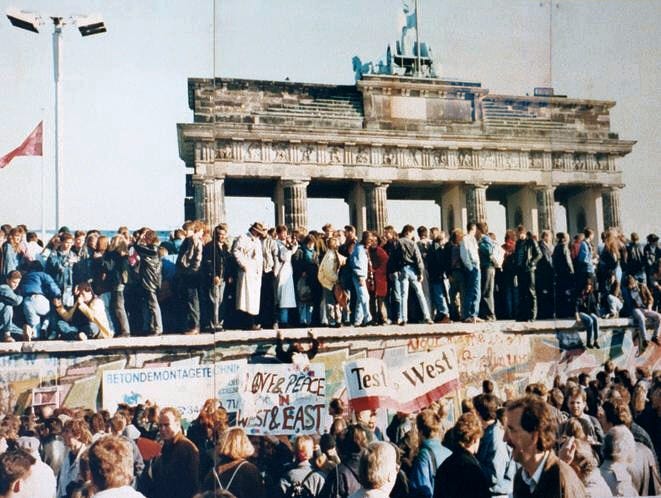
Among Americans aged 18 to 29, the figure was 38 percent. In that cohort, favourable views of communism (38 percent) ran only seven points behind favourable views of capitalism (45 percent), and the generation was the only age group in which favourable views of communism actually edged out unfavourable ones, 38 to 36. Socialism, meanwhile, outpolled capitalism among the young outright: 53 percent favourable against capitalism’s 45. Also, the generational gradient was almost perfectly linear. Favourability toward communism fell from 38 percent among Gen Z to 29 percent among younger millennials, 19 percent among the middle-aged, 13 percent among those approaching retirement, and just 5 percent among seniors, the Americans old enough to remember duck-and-cover drills, Brezhnev, and the Berlin Wall as a piece of functioning infrastructure.
The 2026 Cato survey was not a fluke, which would be plainly obvious to people with even a slight interest in American politics. We also know this was not a fluke because the year before, in March of 2025, a Cato/YouGov survey of 2,000 adults found 34 percent of under-30s favourable toward communism and 62 percent favourable toward socialism. Cato’s senior editor Michael Chapman recorded roughly 52 million Americans aged 18 to 29, reporting a 34 percent favourability figure implying something on the order of eighteen million young people willing to say a kind word about an ideology that the Black Book of Communism credits with approximately 100 million deaths.
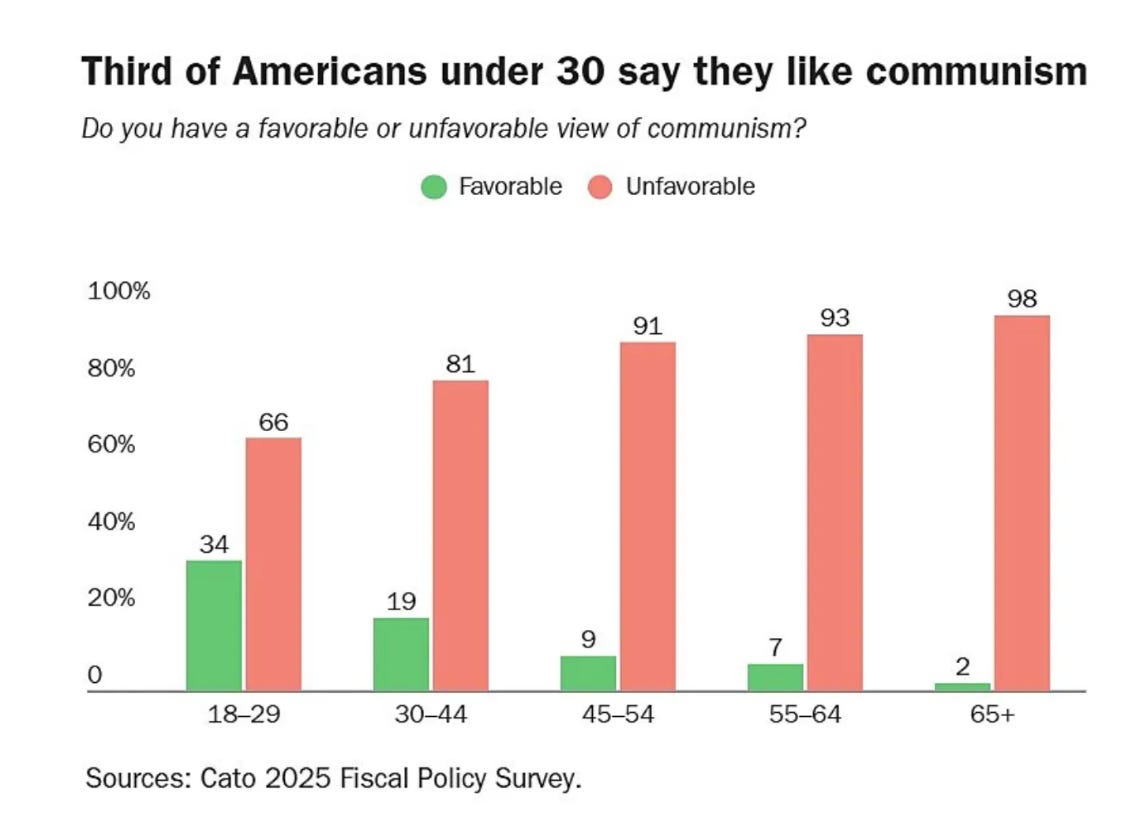
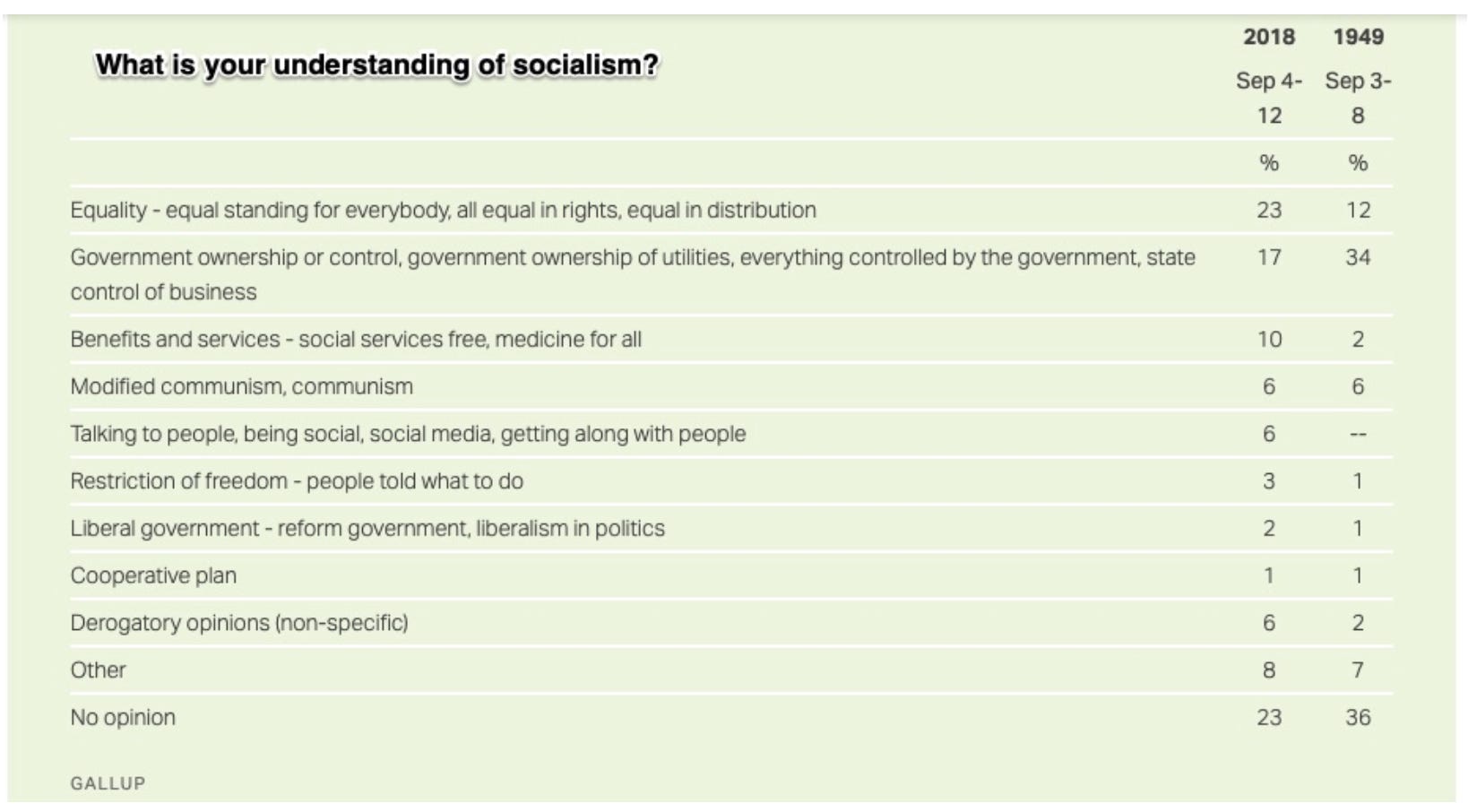
If you know a bit about the history of communism in America, you can understand why these numbers landed the way they did. American attitudes toward communism for most of the twentieth century were not just slightly negative; they were extremely so. Anti-communism was one of the few genuinely bipartisan commitments in American life, embraced by Cold War liberals and conservatives alike. Congress quite literally passed the Communist Control Act of 1954, effectively outlawing the Communist Party. Having any public sympathy for communism was politically and professionally fatal, as evidenced by the loyalty oaths, blacklists, and the House of Un-American Activities Committee (HUAC). When Gallup asked Americans in 1949 what “socialism” meant to them, the largest share answered on the lines of “government ownership of the means of production”, and they wanted no part of it. Communism, the harder and more explicit term, was too unthinkable during that time to even be asked in the poll.2
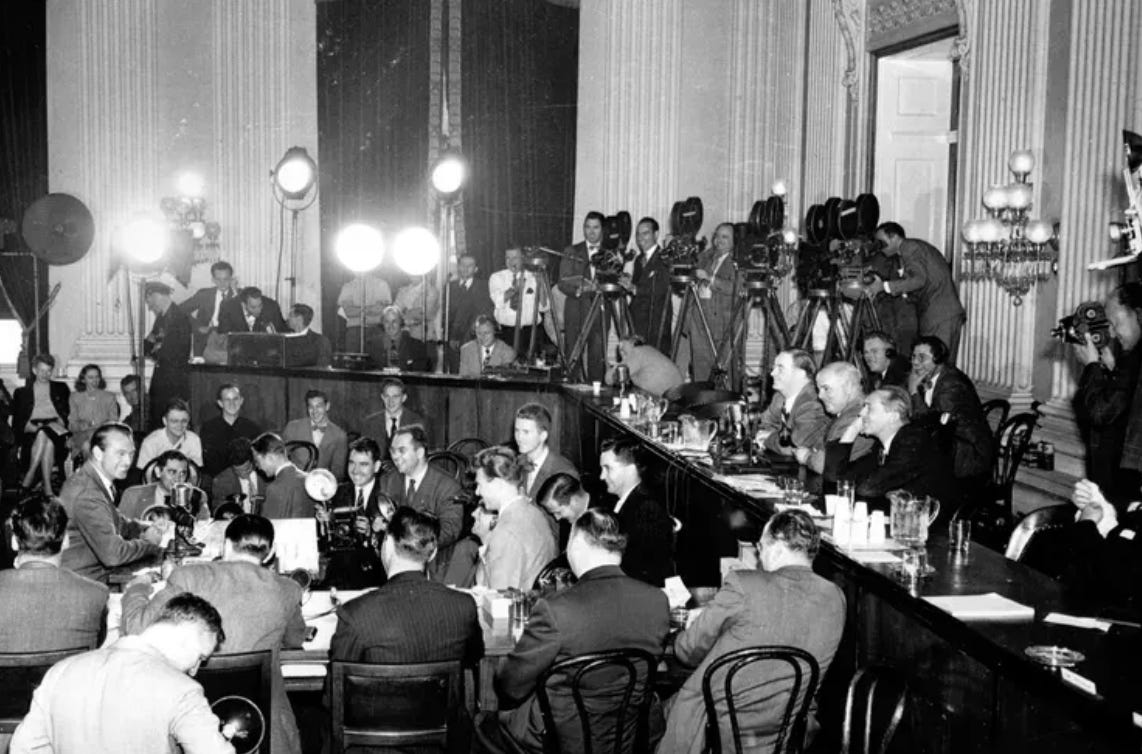
Even after the anti-communist McCarthyite fever broke, the consensus on the issue held for decades. While the New Left of the 1960s attacked the Cold War state, self-described communists remained a vanishingly small and heavily surveilled fringe. After the Soviet Union collapsed in 1991, the communist question seemed pretty much closed. Francis Fukuyama’s “end of history” thesis was mocked almost from the moment it was published. Still, its core empirical observation was hard to dispute: no serious ideological competitor to liberal democratic capitalism remained standing upright.
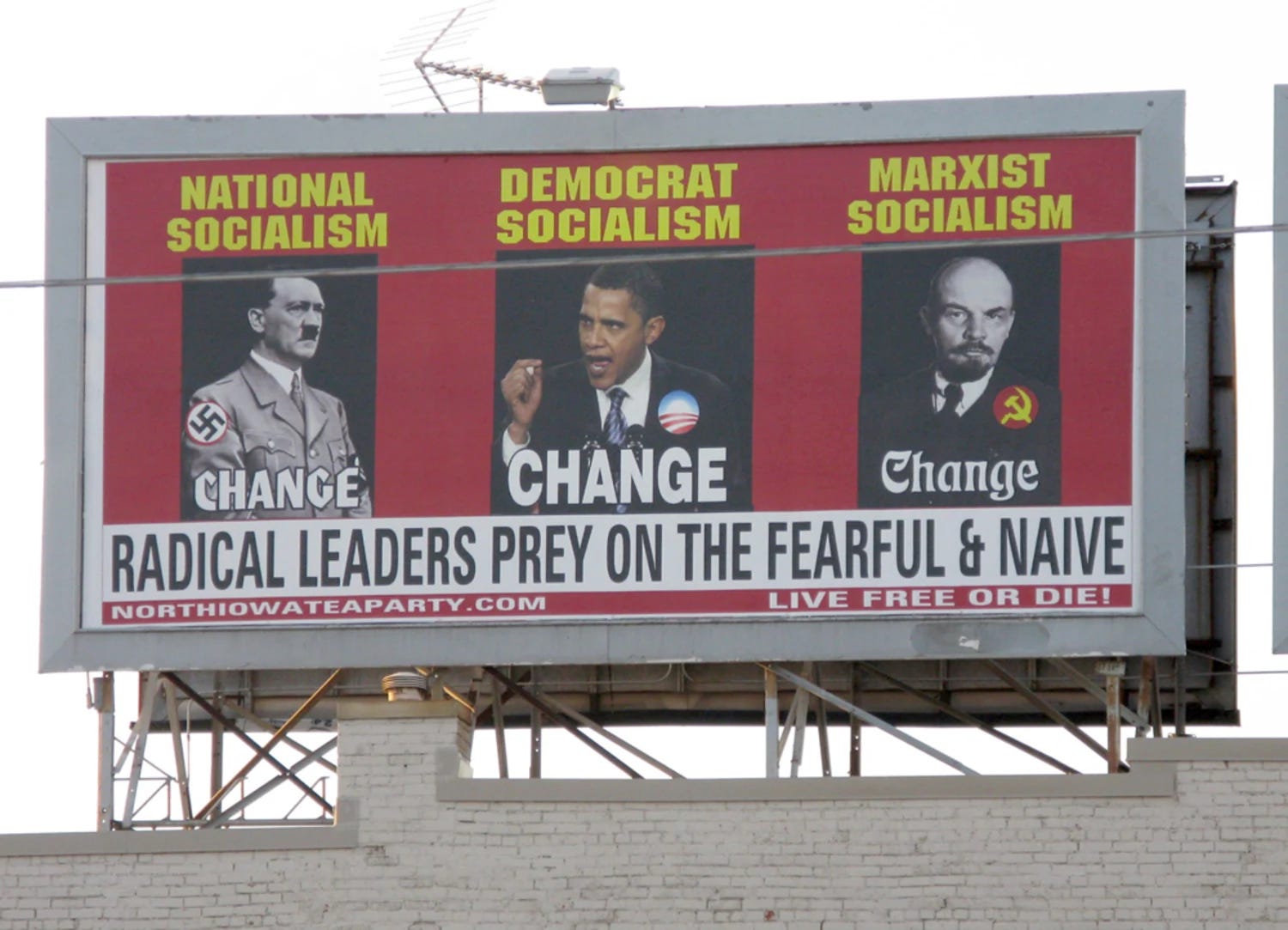
Even in the 1990s and 2000s, the label “socialist” functioned as an epithet, something Newt Gingrich called Bill Clinton, something the Tea Party called Barack Obama. Back then the sting of the accusation depended on the fact that nobody would claim the label voluntarily.

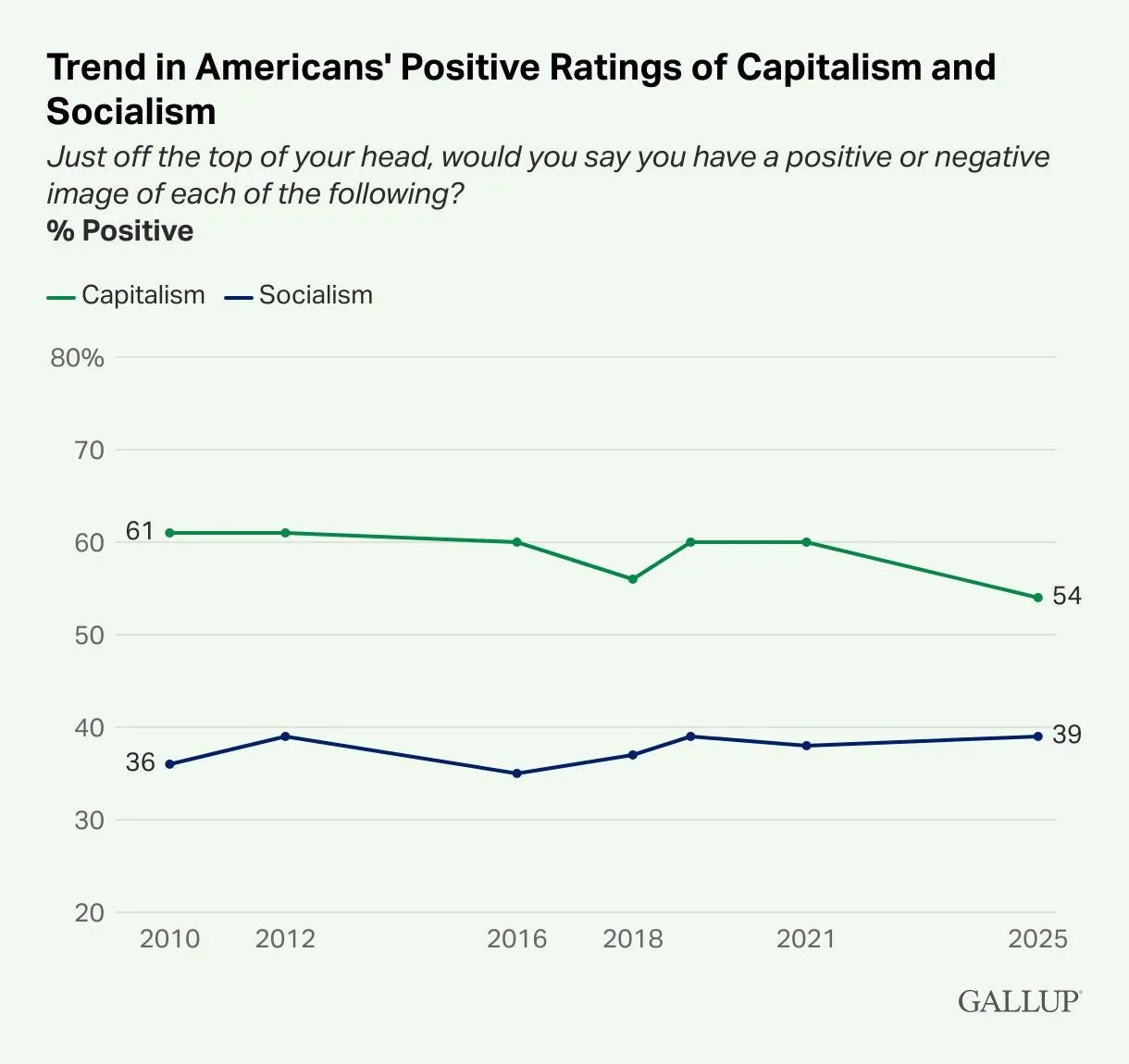
Back then, the polling actually reflected this. When Gallup began tracking the public’s image of “socialism” in 2010, positive responses sat at 36 percent and barely moved for a decade, oscillating in a relatively narrow band between 35 and 39 percent.3 During that time capitalism held mostly steady around 60 percent, reflecting the numbers of a seemingly settled question.
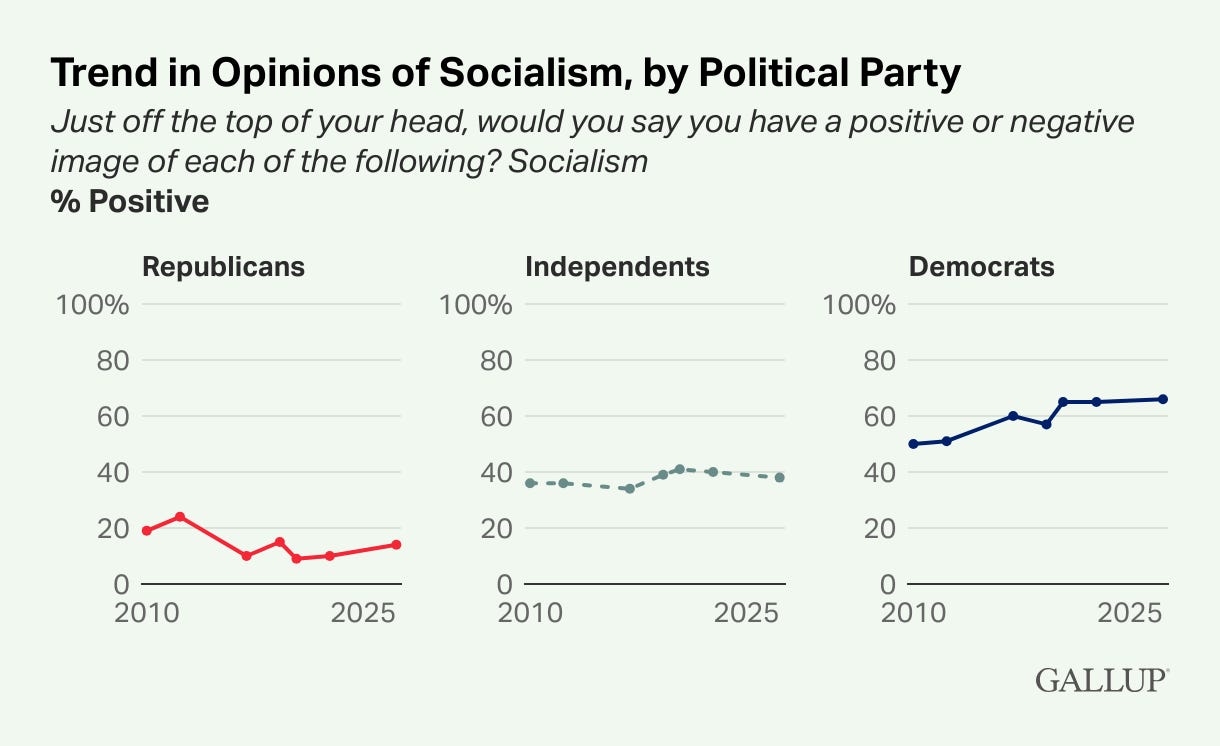
But by 2018, Gallup found that Democrats viewed socialism more favourably than capitalism for the first time in its measurement.4 By 2019, capitalism and socialism were tied among adults under 40, a pattern that has held ever since.5 And by August 2025, capitalism’s overall positive rating had slipped to 54 percent, the lowest Gallup had ever recorded, driven by collapsing enthusiasm among Democrats and independents under 50.6 Among younger Democrats, positive views of capitalism fell from 54 percent in 2010 to 31 percent.7
An entire generation walked out of the consensus while the country’s average opinion barely budged for fifteen years.
This raises the question that this article will spend the next several thousand words trying to answer. How did the country that organised its entire foreign policy, much of its domestic politics, and a good deal of its self-understanding around the defeat of communism produce a rising generation in which the word polls net positive? Is America witnessing the return of revolutionary socialism with cadres and programmes and theories of the state? Or is it watching a generation reach for the most transgressive available shorthand to express its exhaustion with an economic settlement that has not delivered for it?
If you’d like to support what I do, one easy way is by purchasing any books through The Rite Books. Just use the code CELINA at checkout for 5% off, it helps support both the bookstore and my writing :)
Why Young Americans Lost Faith in Capitalism
For Americans born after roughly 1985, capitalism has not kept its side of the bargain, or at least not in the ways their parents were taught to expect.
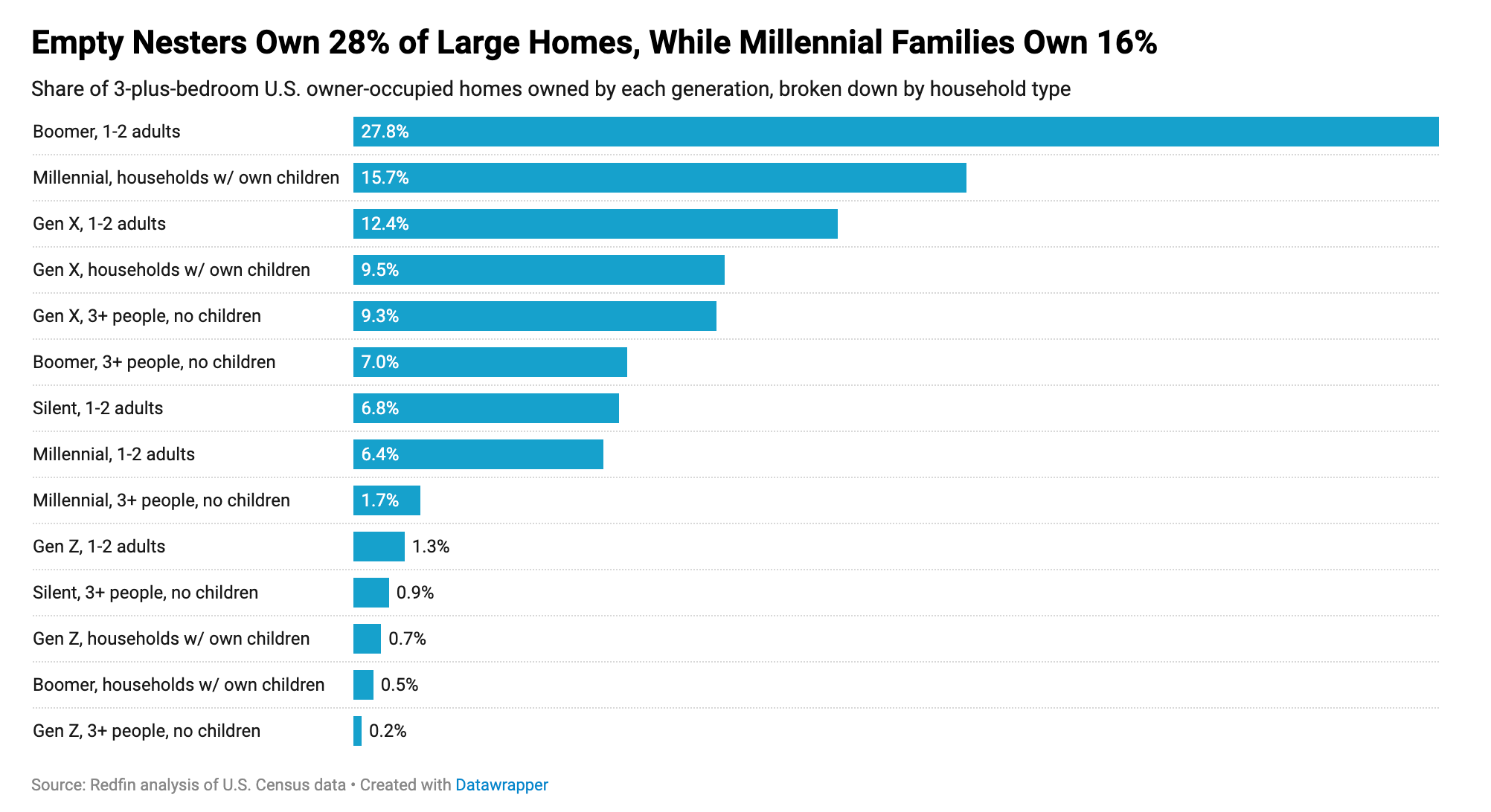
The median age of a first-time American homebuyer reached a record 40 in late 2025, according to the National Association of Realtors, and the share of first-time buyers dropped by roughly a fifth in a single year. Redfin’s analysis of census data found boomer empty-nesters holding 28 percent of America’s large family-sized homes while millennial parents held 16 percent and Gen Z parents held 1 percent.8 Average student debt per borrower roughly doubled between 2007 and 2024, from about $18,000 to about $38,000, and researchers have found a strong inverse relationship between student debt loads and homeownership. A Washington Post analysis found Gen Z workers paying 31 percent more for housing than millennials had a decade earlier, and 46 percent more for health insurance, after adjusting for inflation.9 Federal Reserve data show baby boomers, about a fifth of the population, holding more than $85 trillion in assets, against roughly $18 trillion for millennials and $6 trillion for Gen Z; boomers own over half of all stocks. The Harvard Youth Poll in spring 2025 found just 15 percent of Americans under 30 saying the country was headed in the right direction, and about four in ten describing themselves as barely getting by financially.10
The asset story is perhaps even more important than the wage one. The post-2008 policy regime with its near-zero interest rates, quantitative easing, and enormous fiscal transfers did eventually stabilise the economy. But it did so partly by inflating the price of assets. If you were lucky and already owned assets, the last fifteen years would have made you substantially richer, often without you doing much at all, if anything. If you did not, however, the entry price of the ownership society rose faster than your ability to save for it. The returns to capital were outrunning returns to labour, and which side of that line you were born on mattered more than how hard you worked. It is honestly quite difficult to imagine a more effective curriculum in class consciousness.
Furthermore, the professional-class escape route which entails having a university degree has become simultaneously and paradoxically more necessary, more expensive, and less reliable. By 2025, more than 40 percent of recent graduates were working in jobs that did not require their degree, and graduate unemployment ran above the national average, with the business press openly predicting that artificial intelligence would thin out entry-level white-collar work further.11
Nevertheless, analysts at the American Enterprise Institute argue that the most commonly cited wage-stagnation statistics use 1973 (a cyclical peak) as a base year and the CPI as a deflator, which understates real wage growth, and that a more defensible calculation shows real wages up substantially over recent decades.12 Furthermore, Federal Reserve survey data actually showed the median net worth of under-35 households jumped from about $16,000 to $39,000 between 2019 and 2022, the largest three-year gain on record, and by this calculation the typical Gen Z income is meaningfully higher (inflation-adjusted) than what boomers earned at the same age.13
By global standards, young Americans are rich; nonetheless, by the standards of their own parents’ trajectories at the same age, blocked. Our political attitudes are formed by the second comparison, not by the first one. Literally nobody from the Western world measures their life against a Bangladeshi garment worker or an Indian taxi driver; they measure it against the house their parents bought at 27 on one income.
The word many young Americans have reached for to name that arrangement is “capitalism.”
The Collapse of Anti-Communism
So how is it possible that favourable views of communism is polling at 38 percent among the young? Getting the straightforward stuff out of the way, obviously nobody under 45 remembers the Soviet Union as a functioning adversary and I would wager a large segment of people under 35 know about it at all (at least in a bit of detail). A 20-year-old in 2026 was born a decade after the Wall fell and a full 35 years separates her from the world in which Soviet communism was a live geopolitical fact. It has been suggested before that living memory is the most effective vaccine against political catastrophe, and it expires on a biological schedule. Scholars of collective memory call this the eighty-year cycle, the theory that societies tend to re-run their worst experiments at intervals of roughly one long human lifetime, once the last people who remember the previous run have left the stage.
Nevertheless, the American case also involves the entire pedagogical and cultural apparatus of anti-communism being deliberately dismantled in the 1990s. In American high schools, the curriculum’s treatment of communism has shrunk to a unit on the Cold War. Surveys by the Victims of Communism Memorial Foundation have found large majorities of young Americans unable to define communism accurately or to estimate its death toll within an order of magnitude. The foundation’s 2020 YouGov survey found 49 percent of Gen Z holding a favourable view of the word “socialism” and substantial minorities unfamiliar with figures like Mao beyond name recognition. Similarly, Cato’s 2026 survey found that only about half of Gen Z would affirm that the Founders were courageous leaders, and a fifth admitted they didn’t know enough about the founding to have an opinion at all.
The Rise of the New Socialist Left
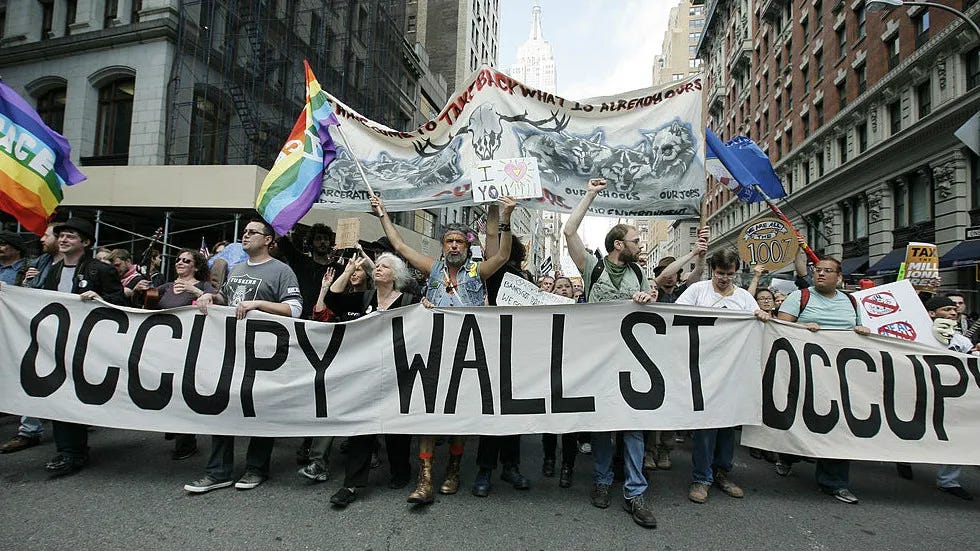
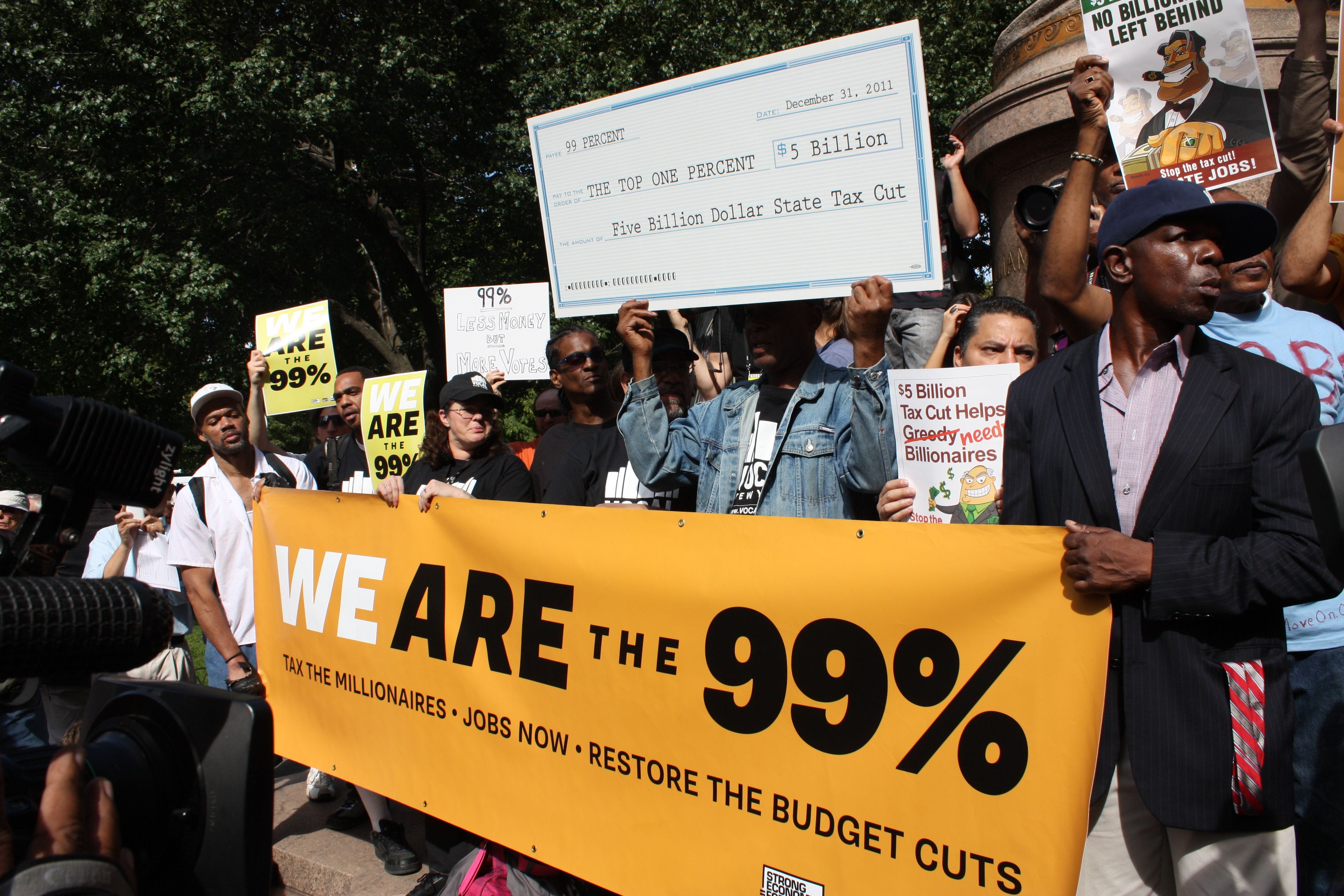
The modern American socialist revival started in Zuccotti Park with Occupy Wall Street in the fall of 2011. Occupy achieved almost nothing by the goals it set for itself: no new laws, no lasting group, no clear demands. What it did achieve was a new vernacular, in the language of the 99 percent” vs “the 1 percent.” Occupy also brought forth a cohort of young activists who had tasted collective politics and gone looking for somewhere to put it.
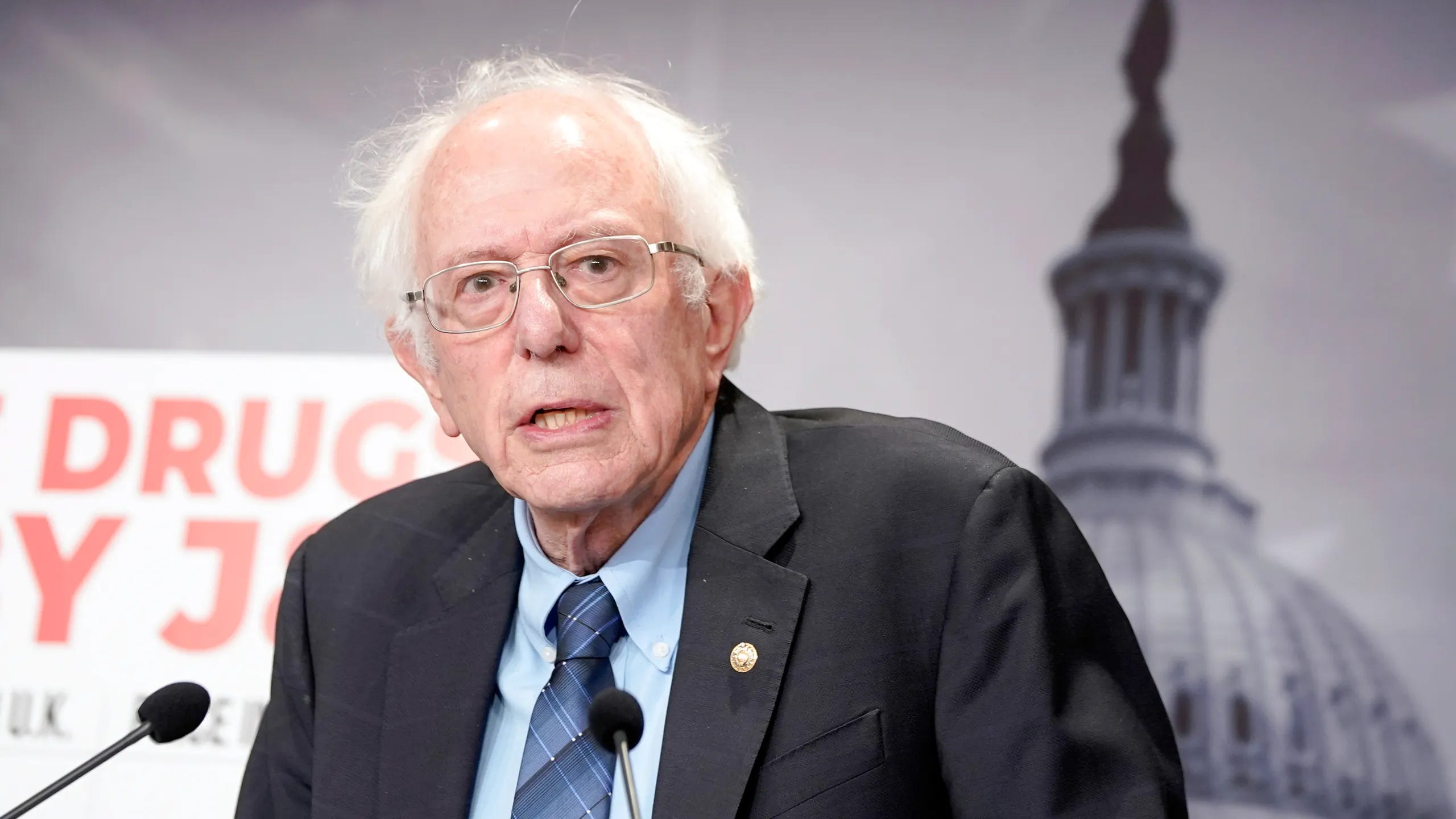
They found it, improbably, in a 74-year-old senator from Vermont, Bernie Sanders. Sanders is a politician who has proudly called himself a democratic socialist for forty years, which nearly all consultants in Washington regarded as electoral cyanide, and in 2016 he won 22 states and more than 13 million votes against the most established candidate in Democratic Party history, and winning voters under 30 by margins that exceeded Clinton’s and Trump’s youth totals combined.14 Sanders demonstrated that the socialist label was survivable, and he built a national donor and volunteer list that constituted the infrastructure of a movement waiting for organisations to claim it.
In 2018, the Justice Democrats, a group that set out to primary establishment Democrats from the left (founded in 2017 by Sanders campaign alums), produced the movement’s second biggest icon, a bartender named Alexandria Ocasio-Cortez, after she unseated the fourth-ranking House Democrat in a Queens primary. The girlboss “Squad” followed from this with Ilhan Omar and Rashida Tlaib. And the Democratic Socialists of America, a sleepy legacy organisation that had puttered along with around 6,000 to 8,000 aging members for decades, became the movement’s institutional vessel almost by default, because it happened to be the largest thing standing when the wave hit. DSA tripled to roughly 25,000 members within a year of Trump’s 2016 victory, reached the mid-90,000s at its pandemic-era peak, sagged during the Biden years, and then, after Trump’s 2024 re-election and a mayoral campaign we will come to shortly, surged past 100,000 dues-paying members by February 2026, making it the largest socialist organisation in the United States since the Debs-era Socialist Party a century ago.15

Around this electoral core accreted a wider penumbra of movement politics, including campus activism, first around fossil-fuel divestment and sexual politics. Then Black Lives Matter brought it roaring back. The protests of 2020 were arguably the largest mass mobilisation in American history, exposing millions of young people to abolitionist theories of policing and prisons that had previously been confined, rightly, to academic departments and activist fringes. After the October 7 attacks, Palestine became the defining cause of the campus left worldwide; it drove the encampments of 2024 and deepened the generational break with the Democratic Party’s foreign-policy establishment. These movements all had different origins, but they drew from a similar pool of young activists. DSA’s new strategy was to turn that loose coalition into something permanent.

By August 2025, more than 250 DSA members held public office in the United States, 90 percent of them elected after 2019. This included nearly a hundred city councillors and county commissioners, sizable socialist blocs on the Chicago and Portland city councils, a cluster of New York state legislators, and a handful of members of Congress. Then in June 2025, a 33-year-old DSA assemblyman, Zohran Mamdani, defeated Andrew Cuomo in New York City’s Democratic mayoral primary, in one of the great upsets of modern municipal politics, and in November he won the general election. On January 1, 2026, in a decommissioned subway station beneath City Hall, Bernie Sanders ceremonially swore in a democratic socialist as the 112th mayor of the largest city in the United States. Mamdani had campaigned on freezing rents, making buses free, delivering universal childcare, and opening city-owned grocery stores, and he promised at his inauguration to govern “audaciously.”16
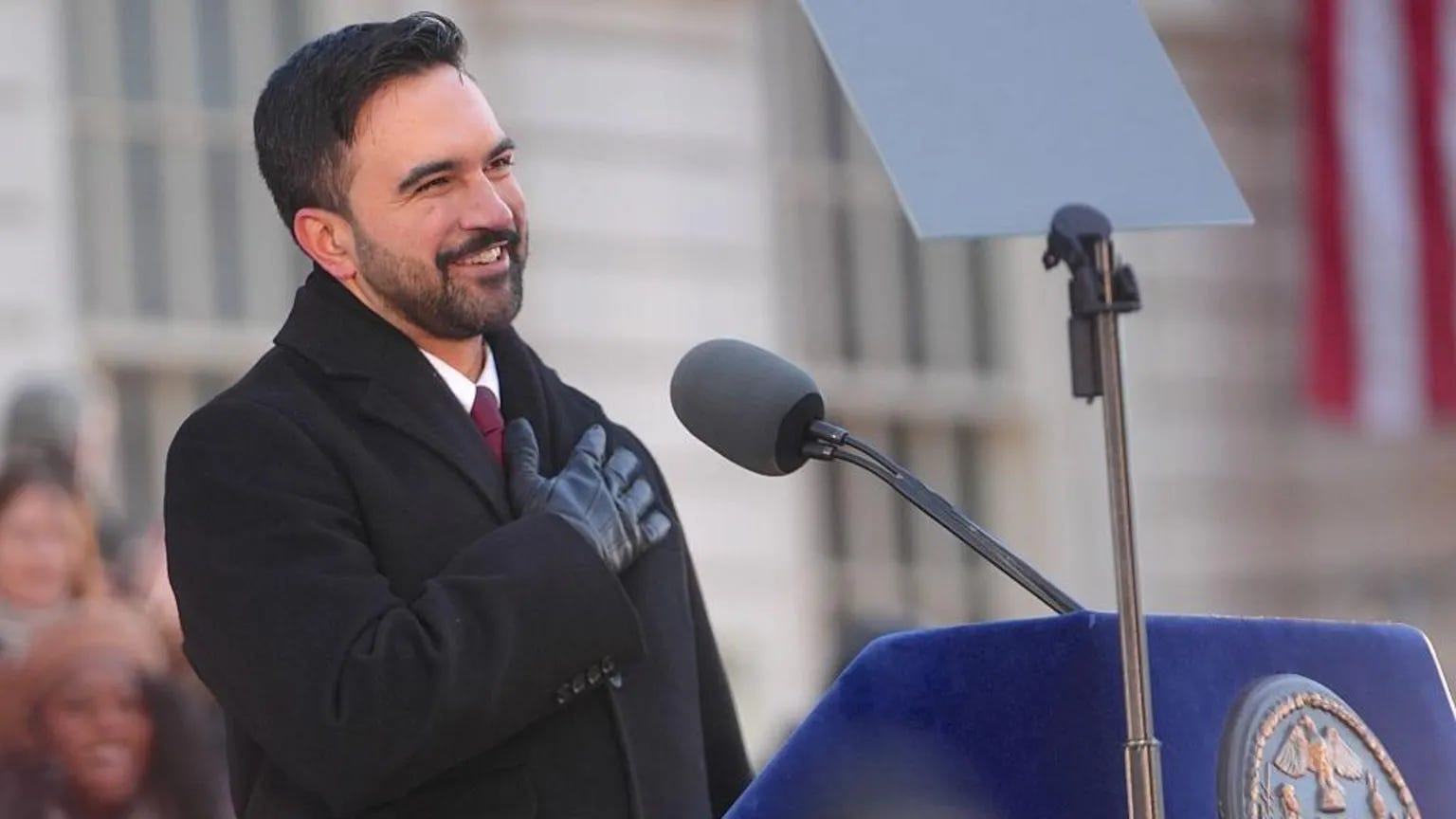
The Mamdani effect on the movement’s morale and membership is hard to overstate. NYC-DSA more than doubled during his campaign, from under 6,000 members to over 13,000. National membership grew from 50,000 in October 2024, the month he announced, to nearly 93,000 by December 2025. And the momentum carried into the 2026 cycle, in June’s New York congressional primaries, three Mamdani-backed insurgents, including a DSA state legislator and a doctoral student who had never held office, defeated establishment opponents, one of them a sitting congressman, while democratic socialist mayoral candidates advanced in Washington, D.C. and Los Angeles. The Hill’s summary was that democratic socialists were rattling mainstream Democrats ahead of the midterms, and DSA’s national convention had already resolved to identify congressional targets for 2026 and to recruit a viable democratic socialist candidate for president in 2028.17
Whatever this is, it is no longer a subculture, which makes it worth asking what the organisation at its centre actually believes.
Inside the Democratic Socialists of America
The DSA was created in 1982 as an act of explicit anti-communism, a fact so much at odds with its current reputation. Michael Harrington, its founder, was the most influential American socialist of the postwar era. He was also a man whose political formation was a decades-long quarrel with Leninism. The DSA was created by merging Harrington’s Democratic Socialist Organising Committee with the New American Movement, on a shared platform of democratic socialism. This socialism was achieved through elections and coalitions inside and alongside the Democratic Party, in permanent opposition to the Soviet model. The organisation joined the Socialist International, the global federation of social-democratic parties like Germany’s SPD. Harrington’s vision was famously modest: to build a “conscience constituency” of liberals, trade unionists, and religious progressives who would drag the Democratic Party leftward. The DSA of the 1980s and 1990s was a big tent of democratic Marxists, Fabians, religious socialists, and labour Zionists, distinguished from the Leninist grouplets to its left precisely by its commitment to pluralism and the ballot.
This specific anti-Leninist identity was written into its rules, as for most of its history, DSA’s bylaws contained a provision allowing the expulsion of members “under the discipline of any self-defined democratic-centralist organisation”. A guardrail aimed squarely at entryism, which is the classic Trotskyist tactic of joining a larger, softer organisation to capture or cannibalise it. Democratic centralism, the Leninist organisational principle in question, holds that a party may debate internally but must present absolute unity in public once a decision is taken; DSA’s founders regarded it as the seed of every authoritarian deformation on the left, and banned it.
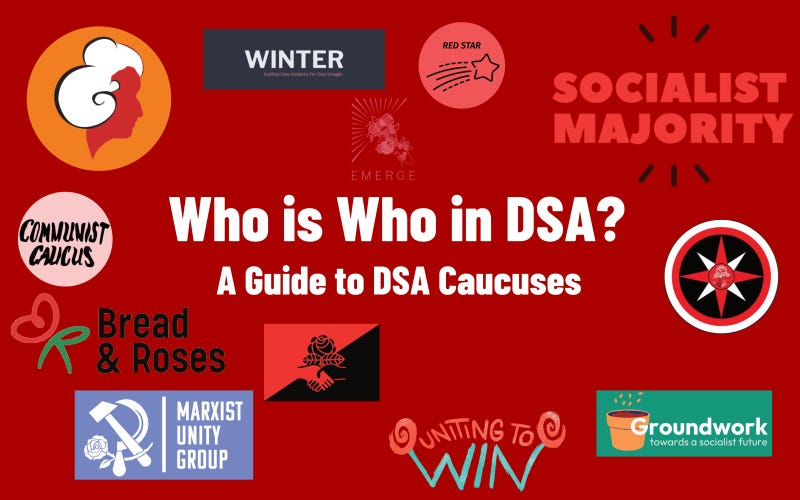
The post-2016 membership explosion arguably changed the organisation’s composition faster than its own self-understanding. New DSA members were overwhelmingly young, radicalised, and largely innocent of, or actively bored by, the old anti-communist quarrels. The internal politics organised itself into publicly declared caucuses/factions. On the organisation’s right (everything is relative) are Groundwork and the Socialist Majority Caucus, broadly reformist tendencies focused on electoral work, coalition with unions and progressives, and making DSA a functional junior partner in Democratic politics. In the middle of the DSA are the Bread & Roses, a Marxist caucus descended from the Jacobin magazine milieu, committed to the “rank-and-file strategy” of salting members into strategic industries to rebuild militant unions—the Bread & Roses functions as the organisation’s swing vote.

And on the left of the left: Red Star, a self-described Marxist-Leninist caucus founded in San Francisco in 2019 and the Marxist Unity Group, founded in 2021–22 in the orthodox Marxist lineage of Kautsky and the early Bolsheviks. Their stated primary plank is replacing the existing American constitutional order with a new socialist republic, including the abolition of the Senate, the Electoral College, the Supreme Court’s veto, and the independent presidency. The left of the left also has a Trotskyist caucus, Reform & Revolution, a Libertarian Socialist Caucus, Springs of Revolution and smaller communist formations, including an NYC-born communist-autonomist caucus called Emerge and, in earlier years, a caucus that called itself the Communist Caucus.
The balance of power shifted at the 2023 national convention, when a coalition formed by Red Star, Marxist Unity Group, and Bread & Roses won a majority of the National Political Committee, displacing the reformist coalition that had governed since 2021. Observers began describing the NPC as a multi-caucus parliament in which majorities must be assembled issue by issue. The 2025 convention, held weeks after Mamdani’s primary victory, confirmed the new dispensation, the left retained its majority, with one sympathetic tally putting explicitly communist-aligned caucuses at a narrow absolute majority of NPC seats, and then the delegates repealed the democratic-centralism ban. Red Star’s literature had described the old clause as a relic of DSA’s anti-communist origins, the Marxist Unity Group openly advocates what it calls the true meaning of democratic centralism, in which members may dissent publicly but must accept and help implement majority decisions. The founders’ firewall against Leninist organisation was voted out of existence, democratically, by a membership that no longer saw the point of it.
The DSA’s 2025 “Workers Deserve More” platform passed 900-291, it included things like Medicare for All, a Green New Deal, universal childcare, tenant protections and social housing, a living wage and collective ownership of key sectors like energy and transit. Convention resolutions committed the organisation to the goal of becoming an independent mass socialist party, while pragmatically declining, in a separate vote, to abandon the Democratic ballot line to a congressional strategy for 2026, and to fielding or backing a democratic socialist presidential candidate in 2028. The convention also reaffirmed maximal positions on Palestine, committing resources to BDS and passing a resolution making “material support for Zionism” an expellable offence.
As documented in the organisation’s own convention records and caucus publications, self-described Marxist-Leninists and revolutionary Marxists now hold a leading position in DSA’s national leadership, that the anti-entryist rule is gone, and that caucuses openly committed to the abolition of the constitutional order operate legally and successfully within it. When Donald Trump told a Faith & Freedom Coalition audience in 2026 that many Democratic Socialist candidates were really hardcore communists, the fact-checkers who scoffed were, on the narrow compositional question, less accurate than he was. It is equally a fact that the median dues-paying member is not a cadre.
From Bernie to Revolution?
On rhetoric, the radicalisation is very much unmistakable. The Sanders campaigns were New Deal restorationism. When Sanders was pressed to define democratic socialism, he pointed to Franklin Roosevelt and Denmark. Basically no one in his orbit at the time spoke about abolishing the Constitution or the police. Yet, a decade later, the discourse is considerably more radical and brazen.
The Marxist Unity Group’s publications describe their unspoken dream as socialist revolution in the United States and their programme as the overthrow of the constitutional order in favour of a new republic. Red Star describes itself without hedging as Marxist-Leninist and argues that elections matter mainly as instruments for building working-class organisation and has successfully fought to write the abolition of police and prisons into DSA’s national platform.
Convention debates feature disputes over anti-Zionism as a membership condition and in one episode, there was a failed attempt to remove a Maoist activist whose small caucus had published a statement sympathetic to the man charged with murdering two Israeli embassy staffers in Washington, a removal blocked by the votes of the left caucuses. On Ukraine, much of the organised left has taken positions ranging from anti-anti-Putin to straightforwardly campist, treating NATO as the war’s primary author. This stance has cost it sympathy among liberals and among Eastern European socialists alike, and sits with the movement’s professed anti-imperialism.
Furthermore, on leadership the shift is also very measurable, as revolutionary caucuses hold the balance of power nationally, and the structural safeguard against Leninist organisation has been repealed.
On operational behaviour, what does the movement actually do? The DSA runs candidates in Democratic primaries, knocks on doors, files legislation about boring but important things like rent and buses. The revolutionary caucuses themselves, whatever their eschatology, behave in practice like especially bookish parliamentary factions. The Bolshevik comparison their opponents reach for founders on an obvious dis-analogy.
What all the factions do agree on is that capitalism must ultimately be replaced, not regulated. The Democratic Party itself is a temporary vehicle, not a home and that Palestine is a defining commitment. The DSA is a genuine spectrum, ranging from social democrats who would be at home in the Danish parliament to a small number of people who would defend, with varying levels of throat-clearing, most of the twentieth century’s communist record.
Is This Actually Communism?
When 38 percent of young Americans tell a pollster they view communism favourably, what proposition, exactly, are they affirming here?
Gallup has asked Americans what “socialism” means to them twice. In 1949, the plurality answer was government ownership of the means of production. By 2018, the plurality answer was equality, vague social generosity, with only 17 percent giving the classical definition. If “socialism” has migrated from an economic system to a synonym for equality, “communism” has almost certainly travelled with it. Cato’s own analysts concede the point, as surveys did not define the terms.
The behavioural evidence of young people also points this way. If we actually look at what the young left votes for and organises around (Medicare, tuition, minimum wage, universal childcare, free buses, etc.), we see this is the policy architecture of Vienna or Copenhagen, not Havana. Mamdani’s mandate, rent freeze, childcare, groceries, are municipal social democracy of a kind that would have been unremarkable in New York’s own past; the city ran extensive public housing, free universities, and municipal enterprise for much of the twentieth century under mayors nobody called Bolsheviks.
Gallup’s most revealing poll may be the one showing “free enterprise” at 81 percent approval and “small business” at 95 percent even as “capitalism” sinks. The same respondents who like communism-the-word overwhelmingly like markets-the-thing.
There is also a pure protest-value component, as for seventy years, “communist” was the most transgressive thing an American could call themself. Perhaps a fraction of that 38 percent trolling the pollster.
Conclusion
Seventy years of anti-communist victory bought the United States a long holiday from an old question in political economy: who gets what, and why, and the holiday is clearly over. The younger generation, for the most part, don’t want a revolution; they just want the deal their grandparents got. The most consequential political question of the next twenty years is whether anyone in the American mainstream is still capable of offering it, because if the centre cannot, the more radical groups have made it very clear that they will keep offering something else.
https://www.cato.org/blog/new-poll-nearly-half-americans-dont-know-what-americas-250th-celebrating
https://news.gallup.com/vault/240749/gallup-vault-americans-views-socialism-1949-1965.aspx
https://news.gallup.com/poll/694835/image-capitalism-slips.aspx
https://news.gallup.com/poll/240725/democrats-positive-socialism-capitalism.aspx
https://redflag.org.au/article/capitalism-zero-likes-from-gen-z/
https://news.gallup.com/poll/694835/image-capitalism-slips.aspx
Ibid
https://www.redfin.com/news/empty-nest-large-homes-2026/
https://www.washingtonpost.com/business/2024/06/22/gen-z-millennials-debt-inflation/
https://iop.harvard.edu/youth-poll/50th-edition-spring-2025
https://rossclennett.com/2026/03/theres-a-crisis-looming-for-tertiary-education-and-many-graduates/
https://www.aei.org/commentary/have-wages-stagnated-for-decades-in-the-us/
https://www.investopedia.com/net-worth-of-americans-under-35-median-wealth-debt-and-financial-milestones-for-young-adults-12004352
https://en.wikipedia.org/wiki/2016_Democratic_Party_presidential_primaries
https://inthesetimes.com/article/democratic-socialists-of-america-dsa-zohran-mamdani
https://www.bbc.com/news/articles/ce8edj7y5z9o
https://thehill.com/homenews/campaign/5987225-democrats-democratic-socialists-midterms/
1989/1990 - No more Reagan or Thatcher. Communist ideas, like Japanese knot weed, are only held back by constant vigilance. Relax your guard and the weed springs back.
The significance of 'culture wars' was not grasped by post Reagan and Thatcher politicians and the weed was allowed to spread from universities to schools and, as students graduated, into most of our institutions. Beating it back is going to be one hell of a job.
They are beginning to realize that cultural Marxism is a dead end. Their utopia of an egalitarian society cannot be built by abandoning material struggles like wages, rents, and the distribution of wealth in favor of social policies centered on race, gender, and sexual orientation.
They were misled by the academic left, which had itself been shaped by institutions and cultural organizations funded by American capitalist interests, including CIA front organizations such as the Congress for Cultural Freedom.