

The Communist Pseudoscience Hiding Inside Civic Nationalism
The conservative belief that peoples can be remade without limit rests on an old communist denial of inherited nature.

Although it’s impossible to say for sure, Trofim Lysenko probably killed more human beings than any individual scientist in history.
In the 1930s, Soviet farmers were taught that a stalk of wheat had no fixed genetic nature. You could chill its seeds, “treat them” the right way, subject them to the right conditions and you could remake the plant entirely, and its offspring would inherit the change forever, in fact, whole harvests were staked on this promise. The harvests obviously failed.
The man behind this spurious claim was Trofim Lysenko, and his ideas are one of the greatest warnings I know for a certain kind of conservative who has not noticed that he borrowed his thinking from an ideology he claims to vehemently oppose.
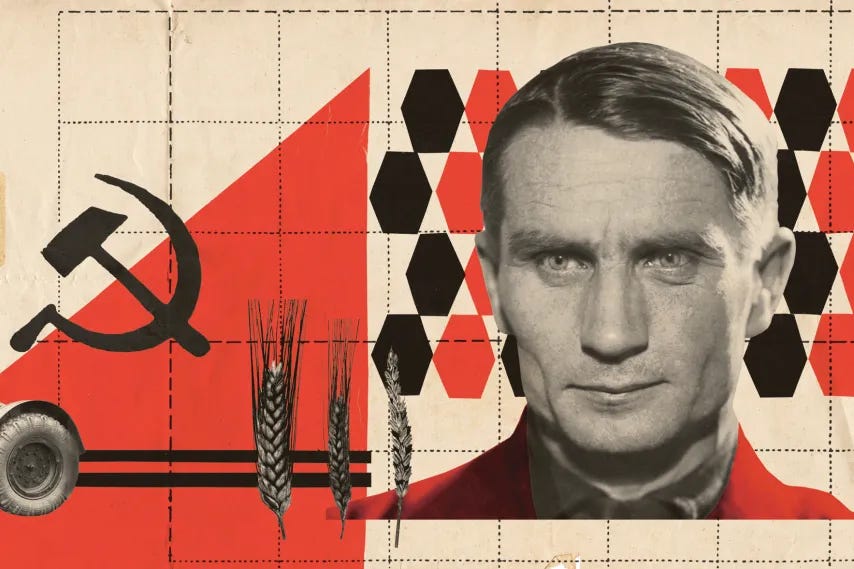
The man who thought you could abolish nature
Lysenko was a Soviet biologist who rose to power under Stalin, he rejected genetics, the science of heredity, which holds that living things carry inside them a set of inherited instructions that shape what they are and pass those traits on to their young. A wheat plant is a wheat plant because of what it inherited, not just because of the field it happened to grow in.
Lysenko denied this, he taught that organisms have no fixed, inherited nature, he claimed that environment and “training,” could transform a plant completely, and, crucially, those acquired changes would become permanent and heritable, passed down to every generation after. There was to him nothing stable locked “in the blood.”
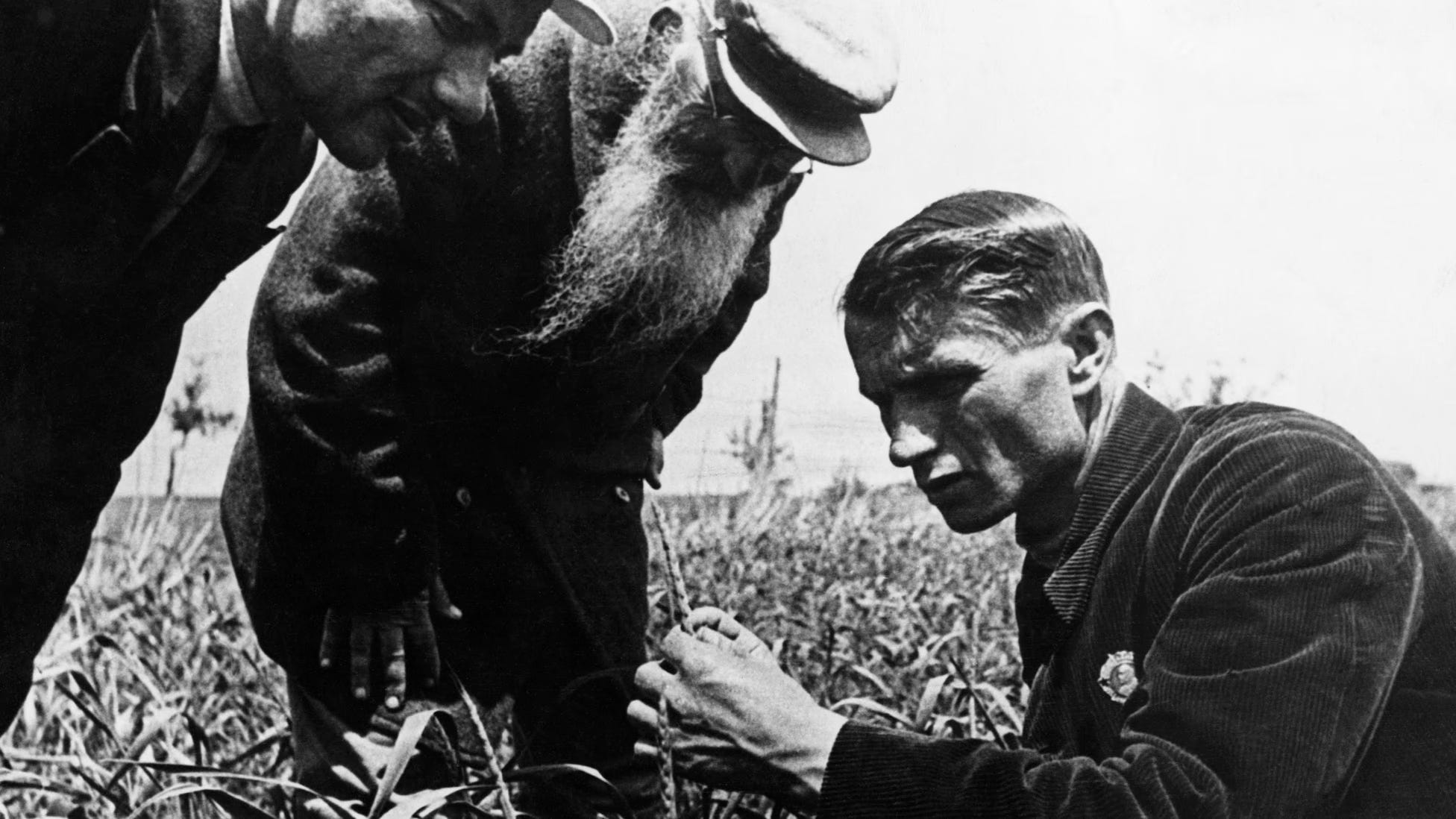
He thought conventional genetics was a bourgeois superstition: reactionary, racist and capitalist, because it insisted that something real and durable was fixed at birth. His own doctrine came to be called Lysenkoism, the belief that living things are infinitely mouldable by their conditions, and that inherited nature is a myth invented by the enemies of progress.
Why Stalin loved it
You can see why the Kremlin embraced this. Communism promised to build a new kind of human being, asserting that if you give people the right system, the right schooling, the right conditions, human nature itself could be poured into a new mould. This is the blank slate, the belief that people (and nature) arrive with nothing written on them, so anything at all can be written on them by whoever holds the pen.
For the Soviets, hard biological limits were not only inconvenient but dangerous and immoral. If nature set boundaries the state could not cross, then the utopia was impossible and the commissars were liars. So the boundaries had to be denied, Lysenko denied them, and Stalin rewarded him for it.
What happened when reality answered
Lysenkoism became official state biology and scientists who defended genetics were denounced, sacked, and imprisoned; many literally died in the camps or were executed. Soviet farms were ordered to follow Lysenko’s methods across the country.
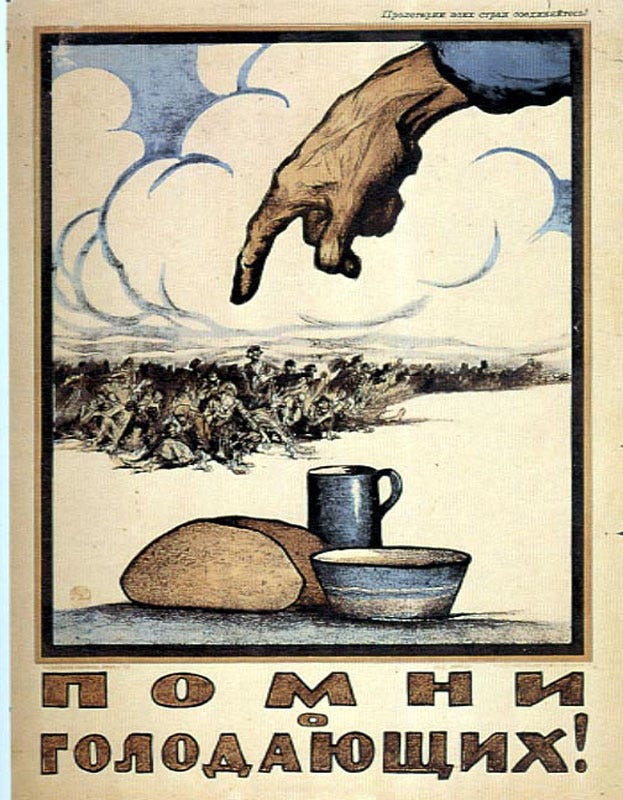
I need to be precise here because it is important to know that the catastrophic famine of 1932-33, which killed millions, was caused mainly by Stalin’s forced collectivisation of agriculture, the seizure of private farms, not by Lysenko. But Lysenko’s reign did its own damage, years of failed techniques, ruined crops, and a Soviet biology so crippled that it took decades to recover.
Today no serious scientist defends Lysenkoism. It is a textbook case of pseudoscience, bogus dogma, believed because it was politically useful rather than because it was true.
The same habit, wearing a different hat
The Lysenkoist habit of mind, that living things are endlessly mouldable, that inherited nature is a fiction dreamt up by reactionaries, did not die with the Soviet Union. It survives, oddly, on the political right, in the doctrine of pure civic nationalism.
Civic nationalism is the idea that a nation is defined only by its laws, its values, its language, and its institutions, never by ancestry, history, or shared peoplehood. On this view, a Frenchman is simply anyone who holds French papers and endorses French values. Nothing deeper is inherited, nothing deeper is required.
Assimilation which is the process by which newcomers take on the language, loyalties, and habits of the country they join, is then treated as essentially unlimited. Anyone, from anywhere, in any number, at any speed, can be converted into a full member of a centuries-old nation just by living there, attending its schools, and accepting its rules. Demographic continuity, the plain fact that a people persists and renews itself across generations, and the deep, slow-moving patterns of a culture are dismissed as irrelevant, or as faintly disreputable even to mention.
If we look at the structure of that claim which is that a people has no durable nature. That is literally Lysenko’s argument. It has simply swapped crops for citizens. The blank slate that communists once applied to the New Soviet Man, some conservatives now apply to the nation itself, and they still somehow call it patriotism.
Conclusion:
Many conservatives who defend this pure civic idea believe they are standing up for traditional patriotism or classical liberalism. In reality they are borrowing a core communist assumption while rejecting it only for agriculture. They accept that wheat has a nature that ideology cannot abolish, yet they insist that peoples and nations do not. They will mock the Soviet Union for pretending plants have no fixed essence, then turn around and insist that the English, the French, the Americans, or the Australians are nothing more than a set of propositions that anyone can adopt overnight.
This is quite literally the operating assumption behind open-border policies, mass low-skill and “high-skill” immigration, and the endless celebration of “diversity” as an unalloyed good. It is why elites can look at the demographic transformation of once-cohesive countries and declare that nothing essential has changed, so long as the newcomers sign a citizenship form and wave the flag on national holidays. It is why pointing out the obvious, that different populations are not interchangeable clay, is treated as the ultimate evil.
Lysenko’s ideas were stupid because living things are not infinitely malleable. A people is more than a legal category, it is a concrete historical community shaped by centuries of shared blood, soil, struggle, and memory. Ignore those realities long enough and you do not get a stronger, more vibrant society (as we all know). You get the same hard collision with reality that Soviet farmers discovered when the crops failed. Calling that collision “immoral” or “reactionary” does not make it disappear, just as it never made Soviet wheat grow in frozen soil. The conservatives who keep repeating the civic-nationalist mantra are applying communist pseudoscience to the one place it can do the most lasting damage: the nation itself.
Lysenkoism – as his theories became known – was an unmitigated disaster. Instead of solving famine, it grew worse. Millions starved as Lysensko’s methods were enforced by the government. Mao Zedong brought Lysnkoism to the People’s Republic of China in 1958; estimates of the people who died in the resulting Great Chinese Famine are as high as fifty-five million.
If you’d like to support what I do, one easy way is by purchasing any books through The Rite Books. Just use the code CELINA at checkout for 5% off, it helps support both the bookstore and my writing :)
This is excellent, and really gets to the heart - or essence - of the matter, in my view. It reminds me, to begin with, of Thomas Sowell's excellent Conflict of Visions, in which he speaks about how the Unconstrained Vision of the Left is rooted in the concept of humans, and human cultures, being endlessly malleable. Yet more deeply, it reminds of something I heard Mary Harrington talk about: the concept of essence as promoted by Thomas Aquinas. This is something that has been largely forgotten about, or ignored, by modernity, but I rather think we need to relearn it in a hurry if our Western cultures are to survive. We cannot just go on pretending that our bloodlines, and the cultures they created over centuries of struggle, are of no value. On the contrary, I believe that they are (literally) essential to our continued collective wellbeing.
Concomitant to the idea of conditions moulding people (notwithstanding what happens when the moulding stops as in Yugoslavia) is Rousseau's pernicious idea of the noble savage. The doctrine of multiculturalism, in tension with civic nationalism, is OK because all people and cultures are inherently equally worthy. Tell that to the thousands of victims of grooming gangs.
In the UK, and no doubt elsewhere, the moulding hadn't worked which is why the UK's Ministry of Justice is trying to stop publication of se and other crimes by nationality. It is partly a reflex of the narrative control state (applicable to many things) but also to avoid exposing the Lysenko lie. The problem is the cat is out of the bag in Denmark and Holland. Do they really think we'll fall for the idea our Afghans and Somali's are different to their Afghans and Somalis who are disproportionately commit sex crimes?
Imagine two large jars of sweets. In one, the native sweets, 1% are poisonous but in the other, with added foreign sweets, 10% are poisonous. You must choose from one of the jars. Which do you choose? Western governments (except Poland) have taken away the first jar and left us with second. Time to tip it over and get back the first jar.
.